Hands & Grip
First The Jar Wins. Then You Start Hiding It.
Stiff hands follow a predictable pattern — worst in the morning, worst in the cold. Understanding why explains what actually helps, and why people wait far too long to do anything about it.
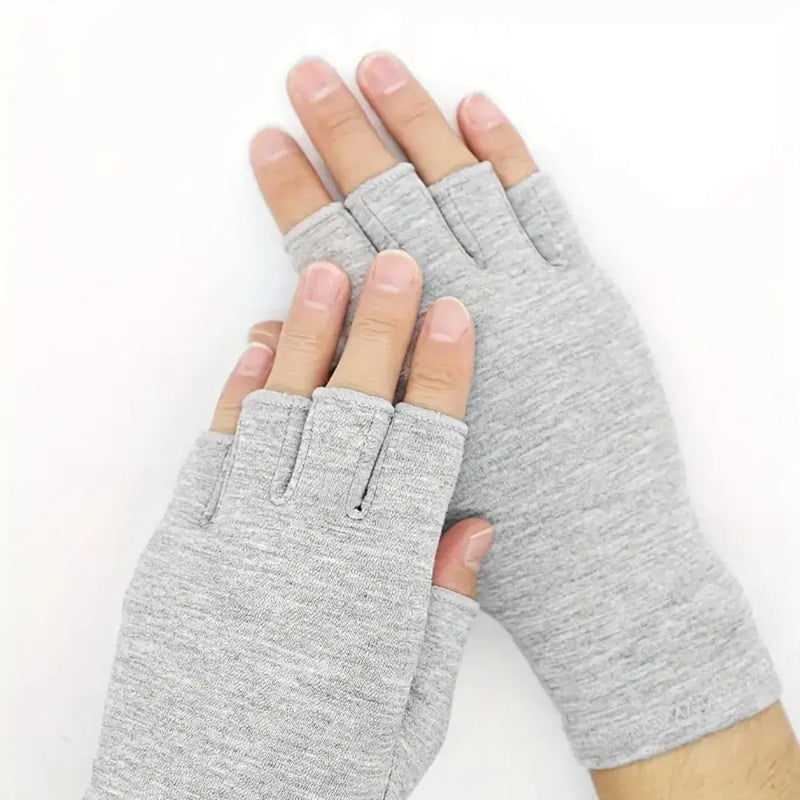
It starts with a jar and it is almost funny the first time. Then it is the shirt buttons, and it is less funny. Then the car key on a cold morning, the zip on the back of a dress, the pull tab on a can.
And somewhere in there, without deciding to, you start arranging your day around what your hands feel like doing. You buy the pre-cut vegetables. You ask someone else to open it, casually, like it does not matter. Nobody announces that they have stopped opening their own jars. They just quietly stop buying them.
Why the morning hand is a different hand
Each finger joint is a small capsule holding lubricating fluid, lined by a membrane. When that membrane is irritated — by decades of use, by wear, by an inflammatory condition — it produces extra fluid.
Overnight, with the hands completely still, that fluid pools and the tissue around each joint tightens. You wake with fingers that feel packed and swollen and a fist that will not fully close. Twenty minutes of movement pumps it back out. That is why the first hour feels like borrowing someone else's hands.
Cold does the same thing in ten minutes
Cold constricts the small vessels in the hands and thickens the fluid inside the joints. That is why the first properly cold week of the year feels like a relapse, and why holding a cold steering wheel or a metal key hurts in a way the same task indoors simply does not.
It is not in your head and it is not you being dramatic. It is temperature acting on tissue, and it is measurable.
The cost is not the pain — it is what you hand over
Ask anyone dealing with this what bothers them most and almost nobody says the pain. They say the buttons. They say having to ask. They say the moment their grandchild handed them a jar and they had to pass it to someone else.
Hands are how independence actually gets expressed day to day. Losing confidence in them is not a small inconvenience — it changes what you volunteer for, what you cook, whether you offer to drive. And it happens gradually enough that you can be well into it before you admit it is happening.
What steady compression is doing
Even pressure across the hand works on three fronts at once. It limits how much fluid can pool in the tissue around the joints — the direct cause of that packed feeling. It holds warmth against the skin, so circulation does not clamp down. And it gives the joints constant sensory feedback, which is why a compressed hand feels steadier through a grip even though nothing structural has changed.
None of this is exotic. It is the same principle applied to every swollen ankle in every clinic in the country. Hands are simply harder to wrap, which is the entire problem a well-cut glove solves.
Open fingertips are the whole design decision
A glove you have to peel off to type, answer the phone, handle a key or do up a button will live in a drawer within a week. That is the honest failure rate of full-finger designs in real life.
Open fingertips mean the glove never interrupts anything you were already doing — which is the only reason anyone keeps wearing them long enough to notice a difference.
The three windows that matter most
Overnight is the highest-value one by far. Compression while you sleep limits the pooling that creates the morning stiffness in the first place, so you wake with a hand that is already half open.
The second is any long stretch of repetitive use: an hour of typing, an afternoon in the kitchen, a session with a needle or a tool. The third is cold — the car in the morning, the walk, the house before the heating catches up.
Add one habit that costs nothing: before you get out of bed, open and close both hands slowly twenty times. You are pumping fluid out before you ask the hands to do anything precise.
What is reasonable to expect, and what is not
Compression does not rebuild cartilage and it does not treat whatever is underneath. Anyone telling you otherwise is selling something.
What people consistently report is a shorter morning — the stiff window shrinking from an hour to fifteen or twenty minutes — and more confidence in grip during the tasks that had started to feel risky. Judge it after ten to fourteen nights, not after one.
When to see a doctor
- Joints that are hot, red and visibly swollen
- Sudden severe swelling in a single joint
- Fever alongside joint pain
- Numbness, tingling or grip weakness that is getting worse
- A diagnosed inflammatory condition — speak to your doctor before adding compression
Nothing here gives you back the hands you had at twenty-five, and you should distrust anyone who says otherwise. But getting the jar, the button and the key back is not a small thing. For most people it is most of what independence feels like.