Joints & Stiffness
Nobody Warns You That The Stairs Go First.
Morning stiffness in the knees is not vague and it is not just age. It follows a mechanical rule — and once you understand the rule, the first hour of your day stops being a negotiation.
It never announces itself. One year you take the stairs without thinking, and the next you find yourself pausing at the bottom, one hand on the rail, doing the arithmetic. Then it is the getting up from a low chair. Then it is the first three steps out of bed, which you now take slowly, on purpose, because you already know how they are going to feel.
Nobody sits you down and explains this. You are just expected to absorb it quietly as the cost of being over fifty. But that pattern — terrible for ten minutes, then almost normal — is not vague and it is not inevitable. It is a specific mechanical event, and it repeats every single morning for a reason.
The knee that improves with movement is telling you something
Pay attention to the shape of it. Worst at 7:02, fine at 7:12. If the joint were structurally failing, walking would make it worse, not better. Instead the opposite happens — which means what you are feeling in those first steps is not damage announcing itself. It is a joint that has gone cold and thick overnight.
Inside the knee, synovial fluid does the lubricating. That fluid is thixotropic: it thickens when still, thins when moved. Seven hours of sleep is seven hours of thickening. Those first steps are you physically stirring it back into something that works.
Then there is the part nobody sees
Add the second layer. In a joint carrying decades of use, the lining is often mildly and chronically irritated. Irritation brings fluid. Fluid inside a closed capsule becomes pressure, and pressure is felt as tightness — the sensation of a knee that is too full for its own casing.
Cold and stillness both make it worse. That is why mornings are bad, why the first genuinely cold week of the year feels like a setback, and why a long flight or a long film leaves you standing up like a much older person than the one who sat down.
Why the ten minutes matter more than the pain
Here is the part that gets underestimated. It is not the discomfort that changes your life — it is what you quietly stop doing to avoid it. You take the elevator. You park closer. You skip the walk. You stop offering to carry things.
None of those feel like a decision at the time. Each one is small and sensible. But a knee that gets used less gets stiffer, and a stiffer knee makes the next decision easier to justify. That is the actual spiral, and it is made of a hundred reasonable choices, not one dramatic injury.
What heat does, mechanically
Applied heat is one of the few things where the mechanism is simple enough to verify yourself. Warming tissue raises local blood flow, which helps move accumulated fluid out of a stagnant area. Warm connective tissue is also measurably more pliable — collagen lengthens more easily at higher temperature, so the same range of motion costs less effort.
There is a reason every physical therapy clinic warms a joint before working on it, and it is not hospitality. A warm joint moves better than a cold one. Every time, in every body, for reasons that have nothing to do with belief.
And why compression is not a gimmick on top of it
Heat alone does not move fluid mechanically — it just makes it easier to move. Gentle kneading and compression do the moving. Think of the difference between leaving a wet sponge on the counter and squeezing it.
That combination is why people describe the knee feeling looser rather than merely warmer afterwards. One changes the condition of the tissue; the other acts on it.
The hot towel is why most people give up
Everybody tries the towel first, and the towel is why most people conclude that heat does not work for them. It cools in about four minutes. It only ever covers the front of the knee, when the capsule wraps the whole joint. And you have to hold it there, which means you quit at minute three and go make coffee.
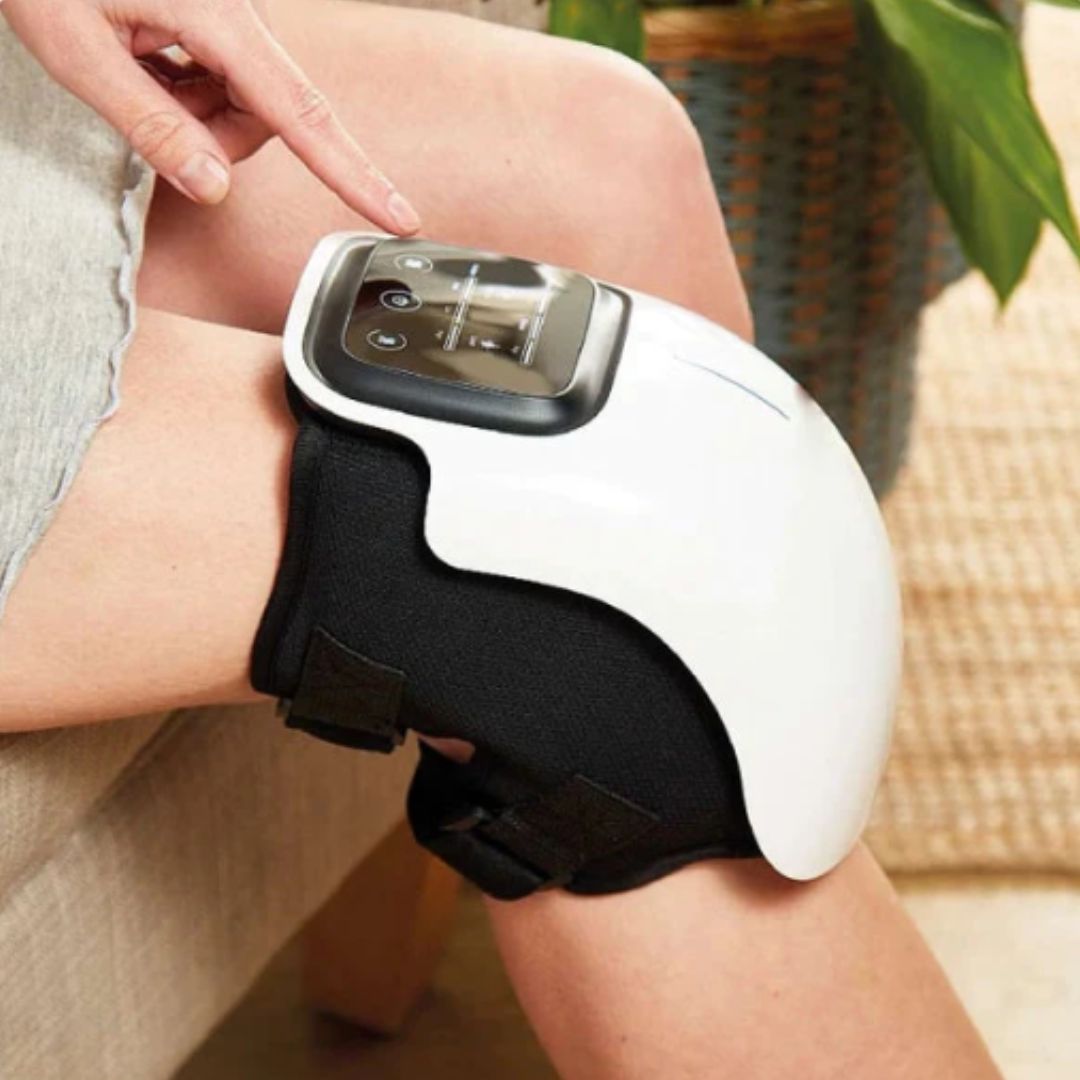
A wrap that holds temperature for a full session, covers the sides and back, and leaves your hands free is not the luxury version of the towel. It is the difference between a three-minute attempt and fifteen minutes — and fifteen is where anything actually changes.
The routine that survives, and what to watch
Twice a day, fifteen minutes: once before the day makes demands, once at the end when accumulated load is highest. Sitting down, coffee or television, no effort required. This survives where stretching programs die because it asks nothing of you except to sit.
One practical note that matters more than it sounds: do it before your morning walk, not after. You are trying to change the condition of the joint before you load it, not console it afterwards.
And measure the right thing. Forget pain scores — count the number of steps before you walk normally. That number is specific, you will remember it, and it is the first thing people notice moving.
When to see a doctor
- A knee that is hot, red and visibly swollen
- Sudden swelling after an injury
- Being unable to put weight on it
- The joint locking or giving way
- Fever alongside joint pain
None of this rebuilds a joint and nothing worn on the outside of the body pretends to. But there is a real difference between a morning that starts with ten minutes of negotiation and one that does not — and that difference is measured in everything you stop declining.