Tension & Posture
It Isn't Tiredness. You've Been Clenching Since Nine A.M.
That tight band across the forehead and the base of the skull is not vague, and it is not simply stress. It follows a mechanical rule — and once you understand the rule, your evenings stop quietly disappearing.
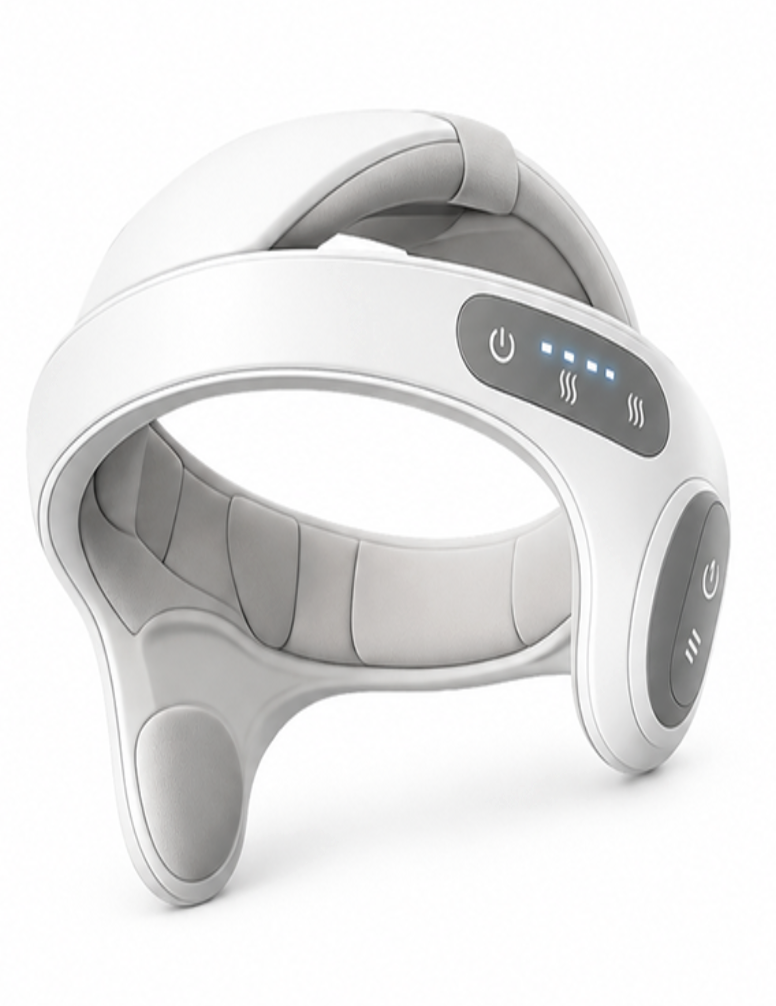
It arrives on a schedule, which is the strangest part about it. Not at noon. Somewhere around six, seven, eight — the hour changes with the person but almost never with the day. A dull band settles across the forehead, the scalp feels tight, and there is a specific spot at the base of the skull that you find with your thumb without looking, because you have found it a thousand times before.
Nobody sits you down and explains this. You are expected to call it tiredness and go to bed early. But something that shows up at the same hour, in the same shape, in the same two places is not tiredness. Tiredness does not have a map. This does.
The pressure that has a shape is telling you something
Pay attention to where it sits. Across the brow. Around the sides. A tight ring at the back, where the skull meets the neck. People describe it almost identically — a hat one size too small, a band being slowly tightened — and that consistency is the clue. Vague fatigue does not draw the same line on thousands of different heads.
The reason is anatomical. The muscle above your eyebrows and the muscle at the back of your head are not separate parts. They are joined by the galea aponeurotica, a broad fibrous sheet that runs over the top of the skull like a tarp pulled tight at both ends. Pull steadily on one end for eleven hours and the whole sheet reports it. That is the band. It is not imaginary, and it is not shaped like a mood.
Then there is the part nobody sees
Add the second layer — the one that runs all day without asking permission. The human head weighs about eleven pounds. Held directly over the shoulders it costs the neck almost nothing. Tipped forward toward a screen, a book, a phone, a kitchen counter, the load on the muscles at the back of the neck climbs sharply, and those muscles do not get to rest, because the alternative is your head falling forward.
So the suboccipitals — four small muscles on each side, right where the skull meets the spine — hold a low-grade contraction from morning until you lie down. A muscle that contracts continuously squeezes its own blood supply: it works while receiving less than it would at rest. By evening it is not tired the way a workout makes you tired. It simply has not let go since breakfast.
Why the evenings matter more than the ache
Here is the part that gets underestimated. It is not the pressure that changes your life — it is what you quietly stop doing once it arrives. You stop reading at night, because the page stops holding. You keep the lamp low. You say you will skip the dinner. You answer in shorter sentences until the room stops asking you things.
None of that feels like a decision at the time. Each retreat is small and reasonable. But an evening surrendered is not given back to you, and the one after it is easier to surrender. That is the actual spiral, and it is made of a hundred sensible withdrawals, not one dramatic event.
What heat does, mechanically
Applied warmth is one of the few things where the mechanism is simple enough to verify yourself. Raising the temperature of tissue widens the local vessels and increases flow through the area — which matters most exactly where a muscle has spent the day squeezing its own supply shut.
Warm connective tissue is also measurably more pliable. Collagen gives more easily at higher temperature, so the same movement through the same tissue costs less effort. There is a reason a physical therapist warms an area before working on it, and it is not hospitality. Warm tissue moves better than cold tissue, in every body, for reasons that owe nothing to belief.
And why kneading is not a gimmick on top of it
Warmth on its own does not release anything mechanically. It changes the condition of the tissue and then waits. Something still has to do the moving — steady pressure across the scalp, the temples, and the ridge at the base of the skull.
It is the difference between warming a stiff piece of dough and actually working it. One makes the change possible; the other makes it happen. That combination is why people describe the head feeling looser afterwards, rather than merely warmer.
Your own fingers are why most people give up
Everybody tries their hands first, and the hands are why most people conclude that none of this works for them. You press your thumbs into your temples, you get about thirty seconds of relief, and then your arms are up by your ears and your shoulders — already the tightest thing you own — are doing more work, not less.
So you stop at a minute. And a minute is not the dose. Something that holds steady warmth across the whole scalp and the back of the skull, keeps the pressure going without your arms, and leaves your hands in your lap is not the deluxe version of rubbing your temples. It is the difference between one minute and fifteen — and fifteen is where anything actually changes.
The routine that survives, and what to watch
Twice a day, fifteen minutes, sitting down: once in the late afternoon before the pressure arrives, and once after dinner. Doing it before is the whole point. You are trying to interrupt a contraction that has been building since morning, not console it after it has already taken the evening.
And measure the right thing. Forget rating the ache out of ten — nobody remembers those numbers by Friday. Count something specific instead: the hour you first reach for your temples, or the number of evenings this week you were still up and talking at ten. Those move first, and they are the ones you will actually notice.
When to see a doctor
- Sudden, severe head pain unlike anything you have had before
- Head pain with fever, a stiff neck, confusion or a rash
- Pain that begins after a blow to the head or a fall
- New weakness, numbness, slurred speech or changes in vision
- Pain that wakes you from sleep, or steadily worsens over weeks
- Any pattern that is clearly new or different after the age of 50
None of this fixes anything, and nothing worn on the outside of the head pretends to. But there is a real difference between an evening you spend and one you sit out — and that difference is measured in everything you stop declining.