Back & Core
Your Lower Back Isn't Weak. It's Inflamed — And It Has Been Asking For Help Since Tuesday.
Why the ache arrives at the same hour every day, what inflammation is actually doing down there, and the one change that breaks the cycle.
There is a clock in your lower back and it goes off around four in the afternoon. Not a sharp pain — a heavy, spreading ache that starts just above the belt line and settles in for the evening. By the time you stand up from the desk you are already doing the small shuffle that people over forty know well: hand on the hip, one careful step, waiting to see what today's version feels like.
Most people treat that ache as a strength problem. They buy a chair, they promise themselves the gym, they blame their age. But an ache that arrives on schedule is rarely about strength. It is about a joint that has been under uneven load for hours, and the inflammatory response your body sends in to deal with it.
What is actually happening down there
Your lower spine has five vertebrae carrying the weight of everything above them. Between each sits a disc, and around them a web of small stabilizing muscles that are supposed to share the job. When you sit for a long stretch — slumped, hips lower than knees, weight tipped back onto the tailbone — those small muscles quietly stop working.
The load does not disappear. It concentrates onto a much smaller area, usually the L4-L5 segment: the last two vertebrae before the pelvis. Six hours of that, five days a week, is the entire story.
The inflammation is not the enemy — it is the alarm
When tissue takes repetitive load it cannot distribute, the body responds the way it always does. It sends inflammatory signals to the area: blood flow rises, fluid gathers, and the nerve endings in the surrounding tissue become more sensitive to everything.
That is why the ache builds through the day instead of appearing all at once. You are not feeling a moment of injury. You are feeling six hours of accumulated response — which also explains the part people find strange, that the pain is often worst at rest, in the evening, and worse still the morning after a bad day. Inflammation does not clock out when you do.
And why it can run down the leg
The sciatic nerve is the thickest nerve in the body and it leaves the spine through a narrow gap, right where that load concentrates. When surrounding tissue swells, the space gets tighter.
The nerve does not need to be damaged to complain — it only needs to be crowded. That is the difference between an ache that stays in the back and one that travels down the back of the thigh, and it is why the second kind shows up after long stretches of sitting or driving.
The mistake almost everyone makes
The instinct is to rest completely, or to stretch hard. Both make sense and both often backfire. Complete rest lets the stabilizing muscles switch off further, so tomorrow the same load lands on the same spot. Aggressive stretching, on tissue that is already irritated, adds tension to a nerve that is already crowded — which is why so many people feel loose for ten minutes and worse by evening.
What breaks the cycle is unglamorous: keep moving, but stop the position that concentrates the load in the first place.
What support does that a stretch cannot
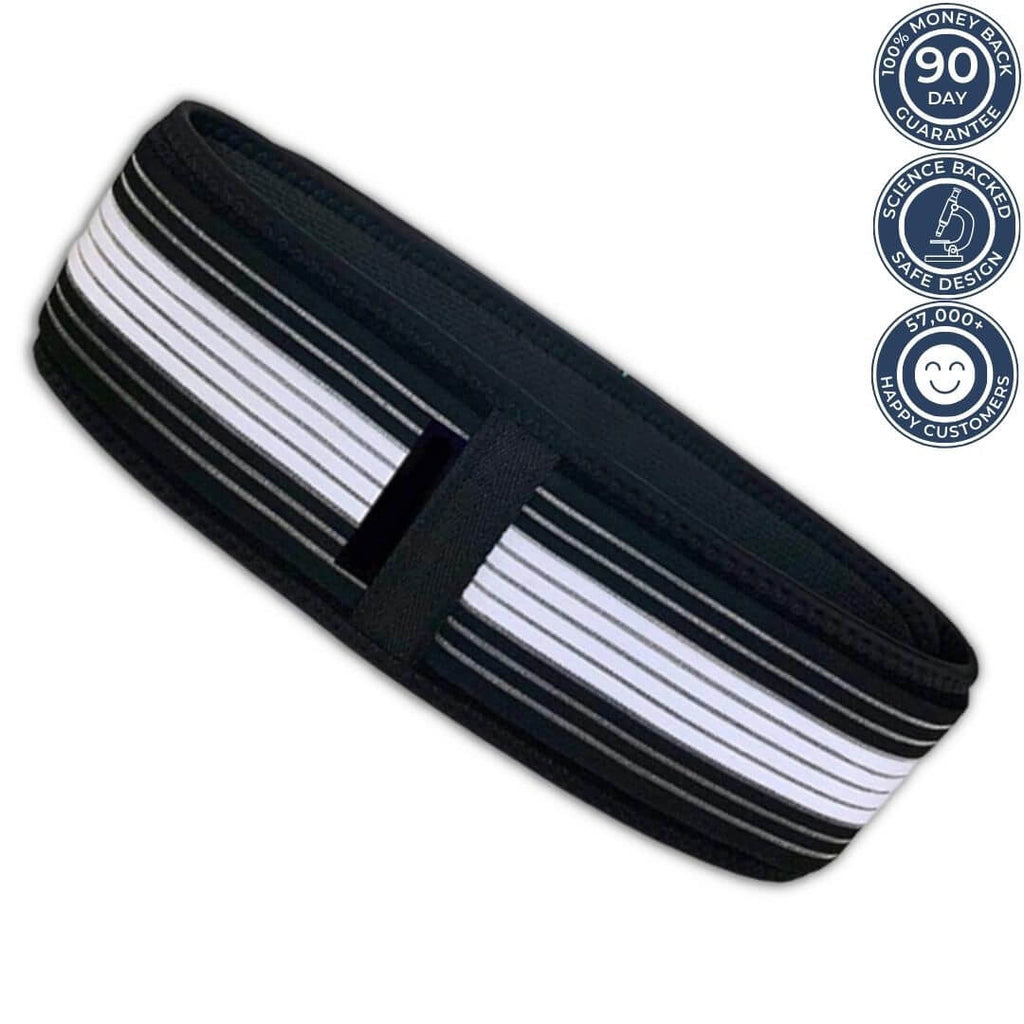
A properly fitted lumbar brace is not a crutch and it does not replace muscle. It does three specific things. It holds the natural inward curve of the lower spine, so load spreads across the whole segment instead of one point. It applies steady compression — the same reason a wrapped ankle feels better, because even pressure calms the sensory noise coming from irritated tissue. And it gives constant feedback: the moment you start to slump, you feel it and correct, before the six hours of accumulation begin.
The dual-strap design matters more than it sounds. A single-band brace pulls evenly, which is fine if your discomfort is even. Most people's is not. Adding tension to the lower panel independently puts the support exactly where the day is hurting.
How to actually use it
The pattern that works is boring on purpose. Put it on before the ache starts, not after — right after lunch, or before a long drive. Wear it through the stretch of the day when you are seated or on your feet longest, then take it off. Two to four hours is typical. It is not meant for sleeping and not meant for all day, every day. The goal is to protect the hours that historically wreck you.
Then add the one movement that costs nothing: stand up every forty minutes and walk for two. Not for exercise — to remind the small muscles they still have a job.
What to expect, honestly
Most people notice something on day one, but not as pain disappearing. What they notice is the evening: the ache that normally arrives at four either shows up later or arrives smaller.
Give it two weeks of consistent use through your worst hours before judging it. If sciatic symptoms are involved, the leg is usually the last thing to quiet down — that is normal, because nerve tissue is slow to calm.
When to see a doctor
- Pain that began after a fall or accident
- Numbness or weakness in the leg or foot that does not come and go
- Any change in bladder or bowel control
- Pain that wakes you every night regardless of position
- Fever alongside back pain
None of this is a cure, and nothing worn on the outside of the body fixes what happens inside it. But a lower back that stops accumulating six unnecessary hours of load every single day is a lower back with a chance to settle. For a lot of people, that is the entire difference.